He used to design websites. Now he breaks concrete for $20 a day
Qassam al-Sane’e, 35, studied IT. In the ruins of Khan Younis he swings a sledgehammer to free iron and tiles a middleman can sell on, one link in a trade that runs from hammer to tent.
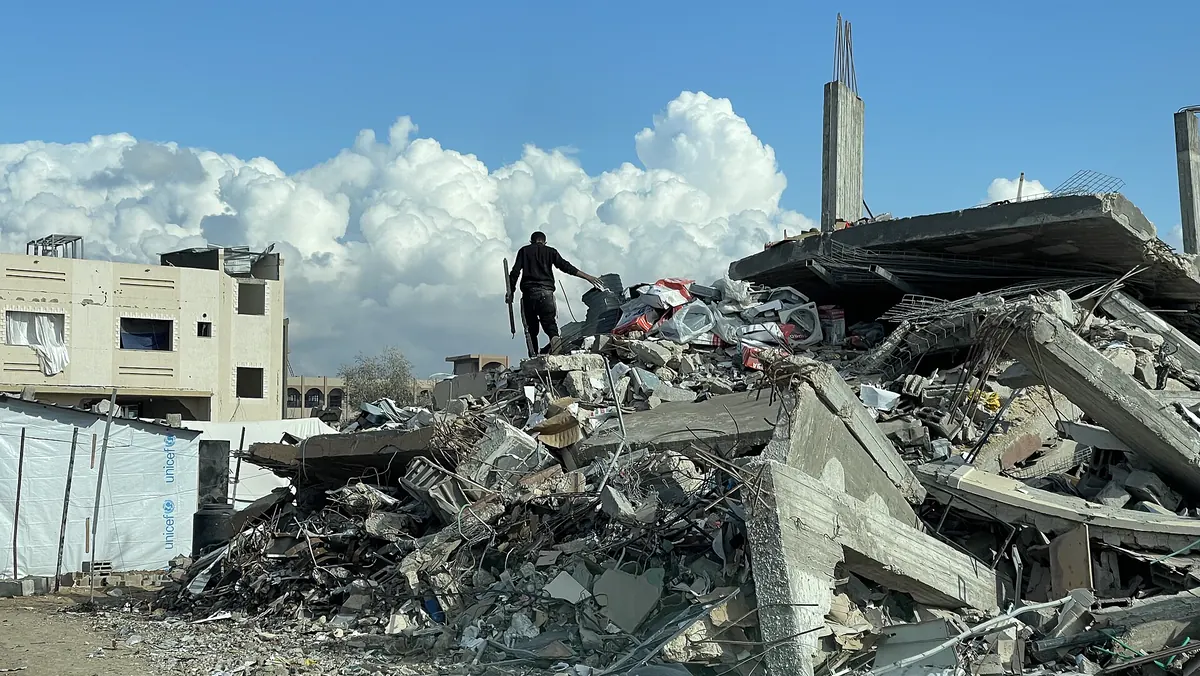
Qassam al-Sane’e used to build websites and repair computers. The war took his computer, his work and his home in Rafah. Now, in the ruins of Khan Younis, he swings a sledgehammer into reinforced concrete to free what can still be sold: iron, tiles, wood, pipes and cable.
A middleman pays him about $20 a day. On it he supports six children, and he sends money to his mother, who is on dialysis in Egypt.
“Never, never. I never even thought for a day that I would do this kind of work.”
No machines
The work is dangerous and done without protection. The crews have no face masks, and they have found missile fragments in the debris.
Nahid Nabil Zo’rub, 33, has worked in demolition for more than ten years. With most heavy machinery destroyed and fuel scarce, his crew of about 15 men breaks concrete with hammers. A building that took two or three days to bring down now takes three or four weeks. At one site the team found human remains and six unexploded rockets and shells.
Saleh Musbah, 33, was a construction worker before the war. He breaks and carries debris for about 12 hours a day for 50 shekels, about $16.50, and around ten people live on his pay. Injuries from falling concrete, he says, are routine.
Tamir Breis, 35, buys what the hammer crews recover and sells it on: tiles to cover the mud floors of tents, wood for shelters, iron for tent frames or for a sorting centre. He has been displaced nine times and lives in a tent where his house stood.
Sixty-one million tonnes
The trade exists because of the scale of what has to be moved. UN figures put Gaza’s rubble at 61 million tonnes. By early October about 907,000 tonnes had been removed, roughly 1.5 percent, a third of it recycled, using seven crushers that were in Gaza before the war, two of them rebuilt by local engineers, Arab News, 7 Oct reported. At this pace the UN estimates clearance will take seven to fourteen years.
Construction itself is running at 1 percent of its 2022 output, Al Jazeera, 7 Oct reported, citing UNCTAD; the same review puts unemployment in Gaza at 78 percent.
For the men on the rubble the arithmetic is shorter. “Fifty shekels, what can that do?” Musbah asked.